In this series, “Understanding the Fluctuations of the Mind,” Jun Adachi, CEO of MENTAGRAPH, engages in dialogue and interviews with experts from various fields to explore what it means to confront and understand the human mind.
The guest for this first installment is product designer Naoto Fukasawa. Since the earliest conceptual stages of MENTAGRAPH, Fukasawa has participated in shaping its philosophy. Through his studio, NAOTO FUKASAWA DESIGN, he also designed the smart ring device “Mentoring 2.”
As the conversation with Fukasawa approaches its conclusion, the discussion shifts toward the relationship between the mind and devices. Yet the starting point is not functionality or specifications, but a more fundamental question: how are the human body and mind connected?
Why a ring? Why something worn on the body?
Through their dialogue, the intentions behind Mentoring 2 gradually come into focus.
Naoto Fukasawa × Jun Adachi in Conversation Designing to “Describe the Mind” and the Concept of “Hari” [Part 1]Can We Truly Understand Our Own Minds? How “Normative Consciousness” and “Hesitation” Shape Our Humanity [Part 2]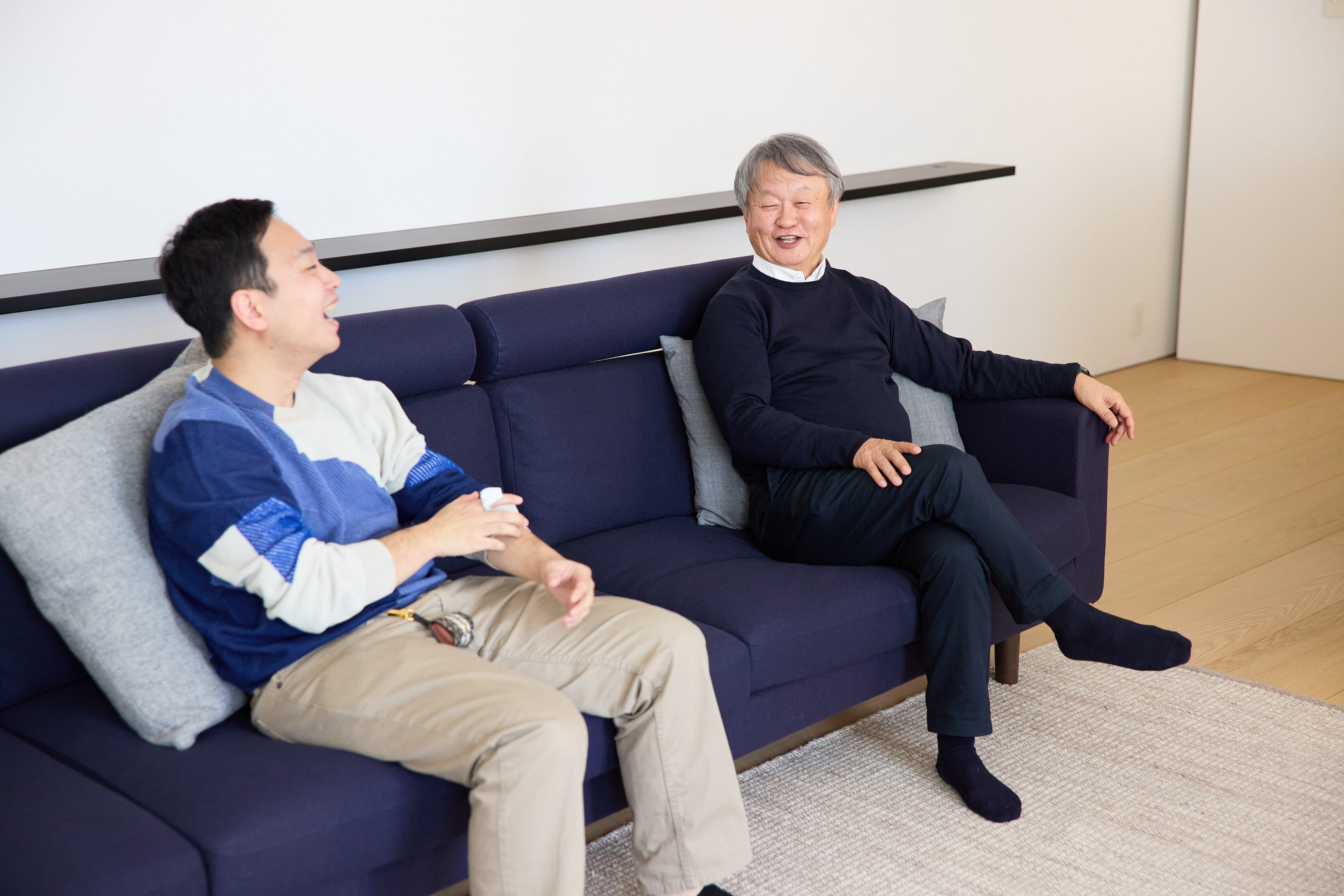
At Mr. Fukasawa's studio. On the right is Naoto Fukasawa, on the left is Jun Adachi, CEO of MENTAGRAPH.
Profile
Naoto Fukasawa (Product Designer)
Representative of NAOTO FUKASAWA DESIGN, Director of the Japan Folk Crafts Museum, and Vice President of Tama Art University. He is widely known for designing products that harmonize with people’s unconscious behaviors, including MUJI’s wall-mounted CD player and au’s INFOBAR mobile phone. Recipient of numerous awards including the Isamu Noguchi Award and the iF Design Award Gold Award.
Jun Adachi (CEO of MENTAGRAPH Inc. / Director of D-LAB, Japan Tobacco Inc.)
At D-LAB, the corporate R&D organization of the JT Group, Adachi has led the planning and development of new businesses and founded MENTAGRAPH Inc. Previously, he worked at a UX consulting firm before joining Japan Tobacco Inc. in 2018.
⚫︎Embodied Knowledge and the Mechanisms of the Unconscious
— “Human beings do not live through the brain alone.” The final part of the conversation begins with this intuition. The body often moves before reason does; it knows before conscious thought begins. These themes become the gateway to understanding what Mentoring 2, the smart ring device, is truly attempting to touch within human beings.
Adachi:
Since the earliest stages of MENTAGRAPH, you have participated in shaping its philosophy. Throughout our conversations, I was particularly struck by your deep interest in “embodied knowledge” and the unconscious.
Fukasawa:
The great pianist Franz Liszt performed pieces that required extraordinarily complex finger movements, simultaneously pressing adjacent keys while sliding rapidly across them. If we assume that the fingers move only after the brain consciously processes each action, the speed simply does not make sense. In other words, it feels as though the fingers themselves are thinking directly, rather than waiting for instructions from the brain. When you think about it that way, the human body is not governed by the head alone. For example, people walk beautifully simply because their feet naturally land in the right place. Almost everyone can do this effortlessly, without conscious thought. Ironically, it is often the brain that interferes.
Adachi:
People say that soccer players perform best when they can play with the same unconscious ease they had as children kicking a ball around. But when rational thought intervenes too strongly, performance can actually deteriorate. The same may be true when it comes to recognizing mental fatigue. Once we start analyzing it purely through logic and reason, we lose touch with it. That is precisely why the fingertips matter — they may be a place where we can receive signals from the body before the brain begins to interfere.
⚫︎The Ring Device as Symbol
— The dialogue naturally moves toward the meaning of things we wear on the body. Why is Mentoring 2 designed as a ring? Why must it exist not merely as a measuring device, but as something continuously worn in daily life? The discussion extends far beyond design alone.
Adachi:
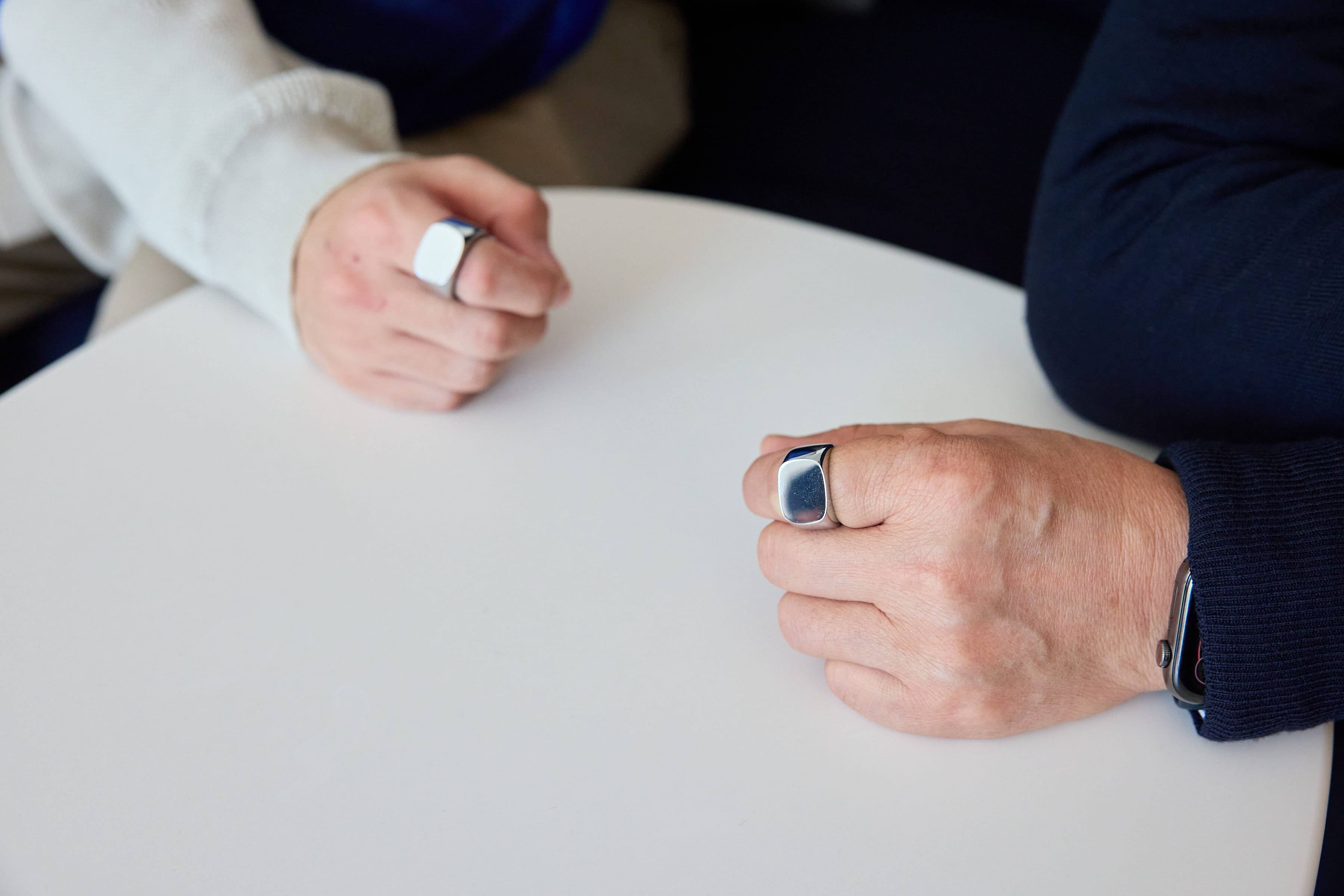
Could you explain again why Mentoring 2 was intentionally designed in the form of a classical signet ring — the type once used by European aristocrats to stamp wax seals?
Fukasawa:
The fingers are the parts of the body that touch countless things. Psychologically speaking, gestures made with the hands often express thoughts separate from spoken language itself.
Moreover, things we wear on our bodies function as special symbols. A wedding ring symbolizes a relationship. Likewise, college rings once symbolized a sense of belonging among students.
Mentoring 2 was designed as a signet ring because I wanted it to function as a symbol that supports the self.
Adachi:
The Mentoring 2 designed by NAOTO FUKASAWA DESIGN was created with a timeless quality — something users would want to wear constantly as a daily companion. We hope it becomes more than a measuring device: something that gently affirms one’s own “mental tension” and quietly accompanies everyday life.
Fukasawa explains that Mentoring 2 was intended to function as a symbol supporting the user themselves.
For that reason, it was deliberately designed in the form of a classical signet ring.
⚫︎Designing by “Not Making People Choose”
— From the details of Mentoring 2, the conversation returns once again to the nature of the human mind itself. The discussion turns toward the relationship between increasing choices and intentionally reducing them.
Fukasawa:
During periods of economic growth, people believed that the more choices available, the better. But in reality, there is less stress when people are not forced to choose endlessly. When something naturally leads you to think, “If this is enough, I do not need the others,” the action concludes smoothly, without hesitation.
Adachi:
That is certainly true. In fact, the MENTAGRAPH app is designed with a similar philosophy. Rather than simply listing massive amounts of biometric data, it visualizes mental condition through a score called “Mental Battery,” generated by a proprietary algorithm. The goal is to allow people to recognize their condition intuitively and simply.
⚫︎Using Data as a Clue to Tune Oneself
— As the dialogue reaches its conclusion, the topic turns toward how science and data should be understood. Can technology become not a provider of definitive answers, but an entrance into deeper self-awareness? On this point, the perspectives of the two speakers gently converge.
Fukasawa:
Science itself does not determine what is good or bad. Its role is simply to provide the technology that measures and captures data from the mind and body.
How Mentoring 2 is ultimately used is left to the user. There is something fascinating about realizing, “Once I understand the condition of my mind and body, I want to experiment with different ways of living.”
The very process of tuning oneself in this way can become a new kind of purpose and vitality in life.
Adachi:
Using data as a clue, people might think, “Maybe I’ll change the time I drink coffee today,” or “Maybe I should rest a little earlier tonight,” gradually adjusting their own rhythm and pace. I believe that understanding the mind ultimately leads to greater personal freedom.
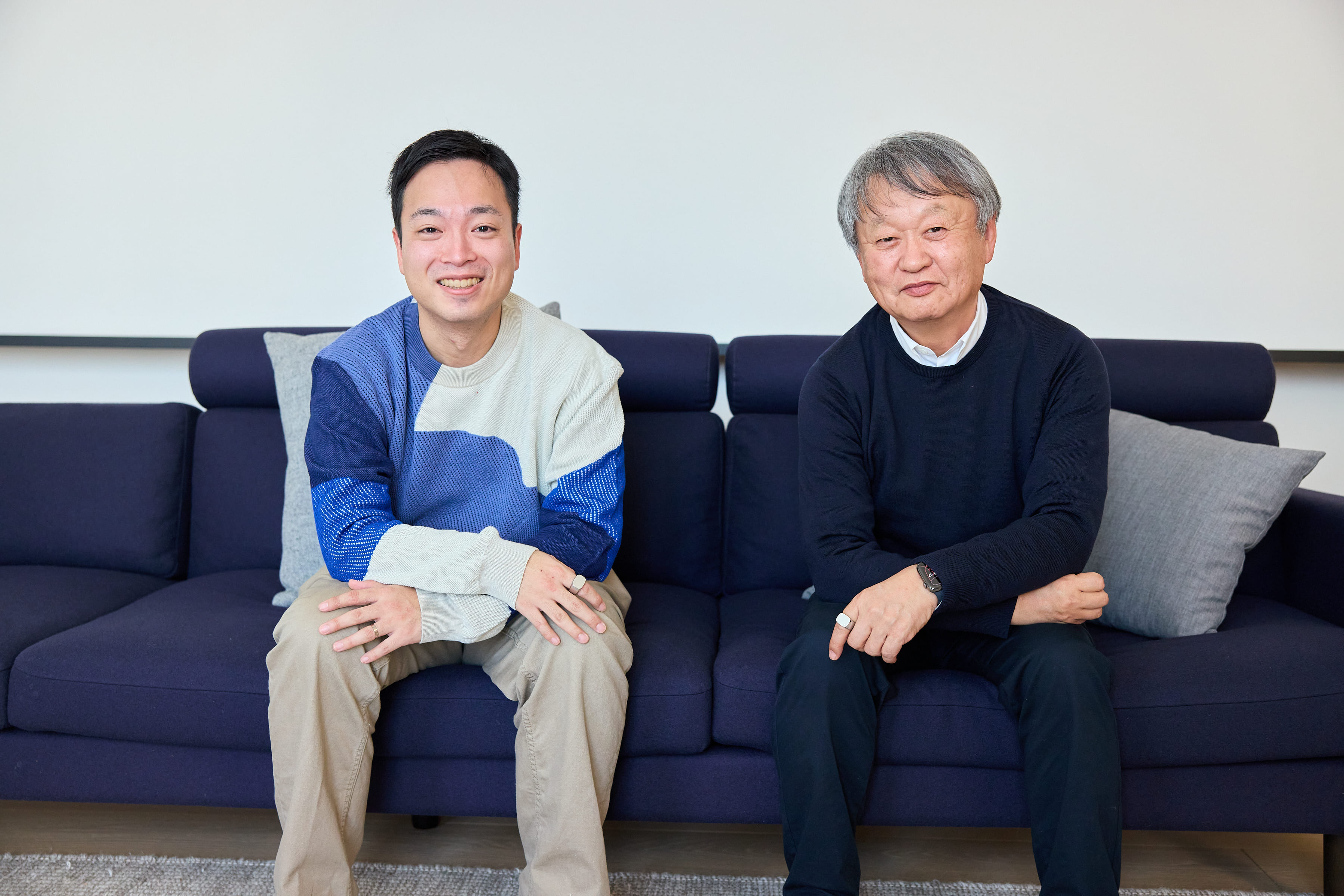
After the dialogue concludes. Fukasawa explains that the very act of tuning oneself through Mentoring 2 can become a source of vitality and purpose in life.
In response, Adachi says he believes that understanding the mind leads to personal freedom.
⚫︎Understanding the Mind Means Becoming Free
Through this dialogue with Naoto Fukasawa, the meaning of “describing the mind” gradually came into view. Technology should not impose answers. Rather, it can serve as a clue that helps people become aware of themselves and begin a dialogue with their own condition.
We hope that the culture of engaging with the mind proposed by MENTAGRAPH may become a step toward living more authentically and freely.
Ralated Articles Can We Truly Understand Our Own Minds? How “Normative Consciousness” and “Hesitation” Shape Our Humanity [Part 2]
Naoto Fukasawa × Jun Adachi in Conversation Designing to “Describe the Mind” and the Concept of “Hari” [Part 1]