In this series, Understanding the Fluctuations of the Mind, MENTAGRAPH CEO Jun Adachi engages in conversations and interviews with experts from various fields to explore what it means to confront and understand the human mind.
The first guest is product designer Naoto Fukasawa. From the earliest stages of MENTAGRAPH’s conceptual development, he participated in shaping its underlying philosophy. At
NAOTO FUKASAWA DESIGN, the studio he leads, he also designed the smart ring device “Mentoring 2”
The conversation took place in Fukasawa’s atelier, located in a quiet residential neighborhood in Tokyo. The carefully arranged space was free of unnecessary noise, creating a stillness that allowed the words exchanged between the two men to stand out all the more clearly.
Their dialogue began with the idea of “hari” — a state in which the forces inside and outside the mind are held in equilibrium — and from there moved naturally into the shapeless yet fundamental question: how should we understand the mind itself?
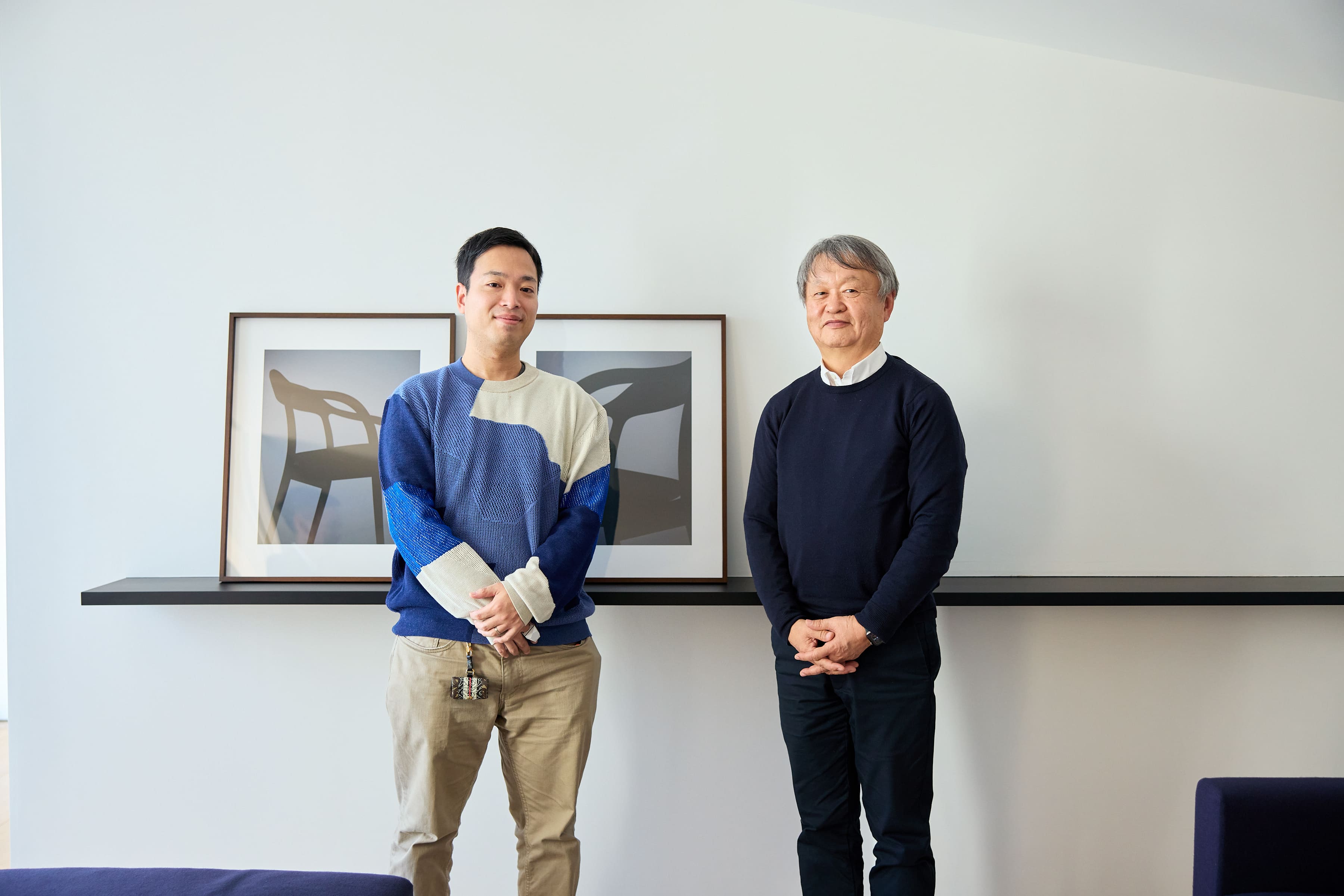
At Mr. Fukasawa's studio. On the right is Naoto Fukasawa, on the left is Jun Adachi, CEO of MENTAGRAPH.
Naoto Fukasawa (Product Designer)Representative of
NAOTO FUKASAWA DESIGN, Director of the Japan Folk Crafts Museum, and Vice President of Tama Art University. Known for product designs that resonate with people’s unconscious behaviors, including the wall-mounted CD player for
MUJI and the “INFOBAR” mobile phone for
KDDI. Recipient of numerous awards including the Isamu Noguchi Award and the iF Design Gold Award.
Jun Adachi (CEO of MENTAGRAPH Co., Ltd. / Director of D-LAB, Japan Tobacco Inc.)At D-LAB, the corporate R&D organization of the JT Group, Adachi leads the planning and development of new businesses and founded MENTAGRAPH Inc. Prior to joining
Japan Tobacco Inc. in 2018, he worked at a UX consulting firm. He continues in his current role today.
⚫︎Visualizing the Invisible State of Mind
—The conversation began by unpacking the meaning behind the phrase “describing the mind.” How do we grasp something invisible, and how do we give it form? The discussion naturally moved toward the core philosophy underlying the MENTAGRAPH project.
Adachi: To begin with, how do you think about the phrase “describing the mind”?
Fukasawa: One keyword we often use in our work is “visualization.” The central idea is to make the invisible visible. In that sense, the word “describe” felt especially fitting for expressing the concept behind MENTAGRAPH. The idea is that, by looking at it, one can intuitively understand a condition or state.
Adachi: During the conceptual phase of MENTAGRAPH, I remember how often the word “hari” came up in discussions with you. At first, I couldn’t quite connect “hari” with “Mental Battery,” the score MENTAGRAPH independently calculates to represent a person’s mental state.
But as I learned more about stress and began designing actual user scenarios for the service, I eventually came to feel that everything ultimately converged on this concept of “hari.”

Adachi reflects that, in the process of conceptualizing MENTAGRAPH, he came to feel that everything ultimately converged on Fukasawa’s notion of “hari.”
⚫︎The Concept of “Hari”: Born from Japanese Sensibility
— The word “hari” was not merely an explanatory term; it was also a deeply rooted sensibility that had long existed within Fukasawa himself. At this point, the conversation moved beyond MENTAGRAPH and into a deeper discussion about where the concept of “hari” originated.
Fukasawa: I was impressed that Adachi-san picked up on the word “hari” (laughs). Back when I was working in California, I was surrounded by designers from all over the world. One day, someone asked me, “What defines expression as uniquely Japanese?” I found myself thinking that perhaps “a person with hari” or “a form with hari” captures something essentially Japanese.
When I explained this idea, one of my designer colleagues said, “If you describe it with a word that already contains all the answers, then what am I supposed to keep searching for?” In her own way, it was a compliment. To those designers gathered from around the world, the concept of “hari” felt that fresh and unfamiliar. That conversation eventually even led to opportunities for me to speak at Stanford University.
What became even more interesting was that when we later tried to turn these ideas into a book, we realized that “hari” simply could not be translated directly into English. “Tension” was too limited; it only conveyed the physical sense of something being pulled taut. So a professor from Stanford’s Japanese department proposed the term “In-tension.” Not “intention,” but “In-tension,” with a hyphen inserted between “in” and “tension,” to express the idea of an inward, internal tension. It was a translation that could only have come from someone with a deep understanding of Japanese culture.
Adachi: The fact that a term like “In-tension” emerged really shows that “hari” carries meanings that go beyond mere physical tension.
Fukasawa: Exactly. At first, I approached it from physical examples — the firmness of a baby’s skin, or the tautness of a yacht’s sail. But that risks reducing it to merely an image of something being lifted upward. So I began considering another aspect of “hari”: the psychological dimension expressed in the word hariai — a sense of purpose, engagement, or emotional resilience.
⚫︎The Balance Between External Force and Inner Resistance
— The conversation about “hari” evolved from physical properties into the human interior. It became a discussion about the balance between the pressures we experience in everyday life and the inner force that allows us to endure them. Within the quiet atmosphere of the atelier, their words naturally evoked vivid human scenes.
Fukasawa: For example, an elderly woman who waters the flowers on her balcony every day — that routine becomes her hariai, her sustaining force. Or consider someone caring for a seriously ill person; the very act of caring can become their hariai. In response to a heavy force pushing against them, they push back and maintain themselves through that resistance.
The most balanced state, then, is when external force and internal force are perfectly in equilibrium. That state itself is “hari.”

Fukasawa reflects on how, while working in California and searching for a uniquely Japanese mode of expression in design, he arrived at the concept of “hari.”
Adachi: So it’s a condition in which pressure from the outside and the force pushing back from within are balanced.
Fukasawa: Yes. We cannot truly know our own minds, nor can we accurately measure how hard we are trying or how exhausted we are. But when immense pressure is being applied, by observing the magnitude of that external pressure, we can begin to see how strongly the mind is resisting it — the “hari” that allows us to endure.
That’s why I felt that the act of first putting on “Mentoring 2” and objectively observing oneself aligns perfectly with the concept of “hari.” It is a way of understanding one’s own state indirectly, through the forces acting from the outside.
⚫︎What “Hari” Asks of Us
Beneath the phrase “describing the mind” lies the quiet dynamism of “hari”: the balance between invisible inner and outer forces. Every day, all of us unconsciously live while resisting and negotiating external pressures.In the next installment, the conversation will delve further into themes such as stress and the “invisible mind” — both of which play essential roles in generating “hari.”
Related ArticlesCan We Truly Understand Our Own Minds?How “Normative Consciousness” and “Hesitation” Shape Our Humanity [Part 2]Eliminating the Noise of the Brain and Listening to the Voice of the Body — Rethinking the Relationship Between Mind and Devices [Part 3]