⚫︎"The Self" Is Made of Relationships
Adachi: At MENTAGRAPH, we work on visualizing changes in our mental state—the "fluctuations of the heart." We measure biometric data with our smart ring "Mentoring 2," and use our app "Mental Battery" to make mental fatigue visible. Our aim is to give people a chance to notice and engage with their own state. How do you understand the "fluctuations of the heart," Mr. Matsuyama?
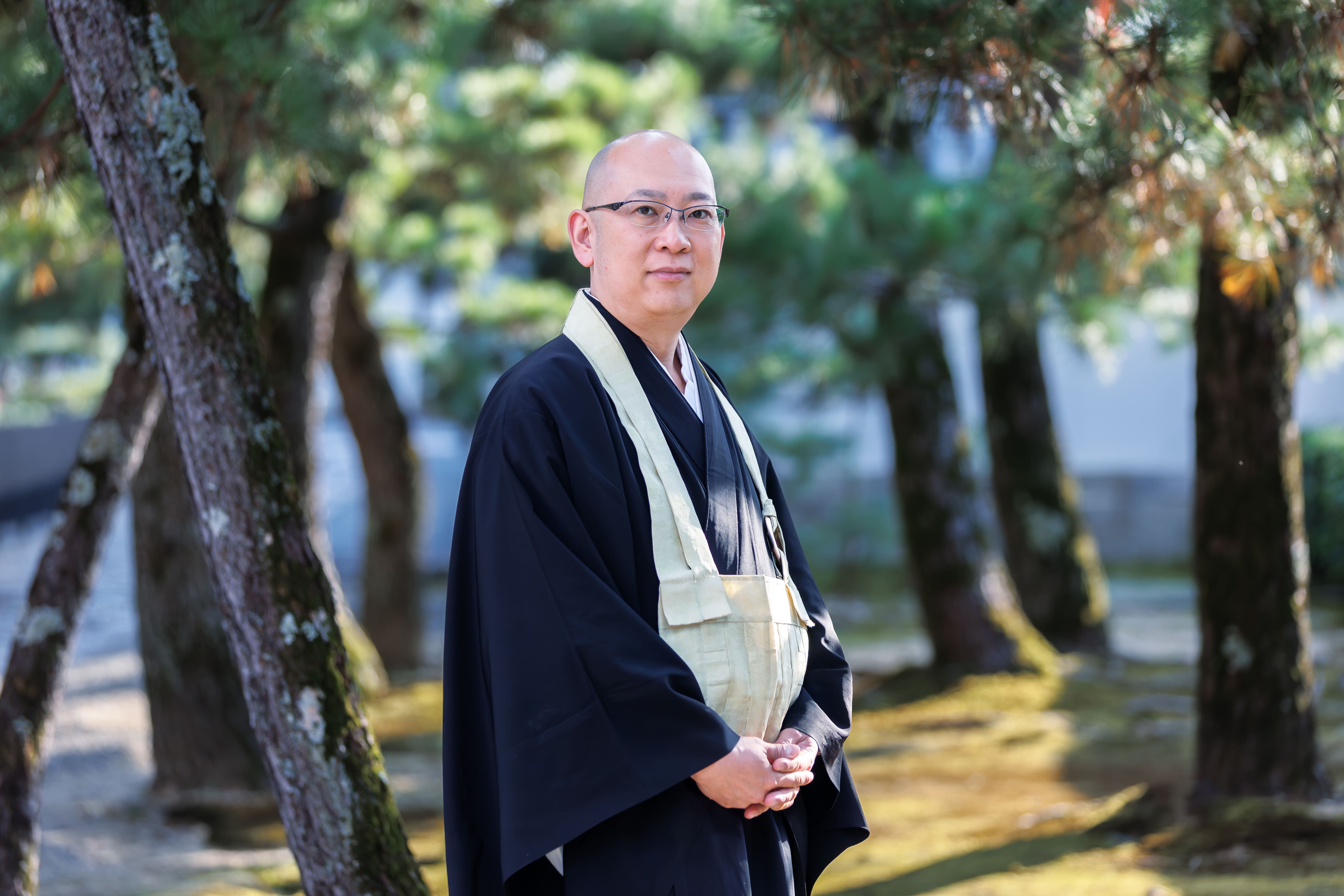
Matsuyama: In Buddhism there is a teaching called shoho muga. Western philosophy presupposes the existence of the independent individual, but Buddhist thinking is different. It's the view that the self comes into being for the first time only within relationships with one's surroundings.
Adachi: So the self exists within relationships?
Matsuyama: Yes. For instance, right now I'm speaking as a monk, but in front of my daughter I speak as a father. The self changes depending on the relationships around it. So naturally, the fluctuations of the heart also change when relationships change.
Adachi: I see. I've always felt that humans are creatures profoundly susceptible to their environment. Even when you think you haven't changed, your state of mind shifts when the person you're talking to changes. Is it close to the idea that we are unconsciously changing all the time?
Matsuyama: Exactly. My younger daughter was attending kindergarten until recently, and once she graduated and I no longer had to drop her off and pick her up, I felt terribly lonely. Even though I hadn't graduated from anything myself. The reason for the loneliness is that the relationships I had with the teachers and with my daughter through those daily trips were gone.
Adachi: So the disappearance of the relationship itself is the loneliness.
Matsuyama: One of my temple's parishioners had been caring for his bedridden mother for a long time. Toward the end, they could no longer even exchange words. But the moment she passed away, he realized: "I was being supported by that bedridden mother all along." Setting aside whether one can speak or not, simply being there is itself a relationship, and it shapes one's own position in the world. Whatever form the communication takes, the self is constituted within relationships with others. This is the Buddhist way of seeing things.
Adachi: It feels like action and reaction. Even just having someone's presence there, we are being supported. I feel that's a very important perspective for understanding people.
⚫︎The "Awareness" Visualization Creates—and Its Pitfalls
Matsuyama: I've been wearing a smartwatch myself for the past few years. The reason was a bit unusual—I happened to share a meal with a smartwatch designer in Silicon Valley. He was of Indian descent, and very devout about religion. He said, "New technology always gives rise to new ethical problems. The wisdom of religion can help us confront those gray areas." So I promised, "When I get back to Japan, I'll buy one, and I'll tell you my impressions next time we meet"—and I started wearing it.
Adachi: Once you actually started wearing it, did anything change?
Matsuyama: Since it makes visible how much I'm moving, my exercise clearly increased. "I haven't moved much today, so let me walk a little more." I think the same applies to mental health—being able to tell, "I've packed in too much this week," or "I need to rest a bit," is very meaningful.
Adachi: That's exactly the kind of triggering awareness we want to deliver.
Matsuyama: But there's one thing I worry about. Suppose the mental numbers aren't good—with the body, you can move forward positively, thinking "I'll exercise more." But with mental health, if you're shown even worse numbers while you're already feeling down, I wonder if it might send you spiraling further.
Adachi: You're absolutely right, and that's the area we design most carefully. We use the concept of "mental fatigue," and we start from the premise that simply living through a day naturally tires you out. So it's natural for the numbers to decline, and from there we design things to guide you toward "let's switch gears and rest." Resting is a fine action too, and even running away is one option. But run away too much and you become unable to face things, so we're always conscious of that balance.
⚫︎Creating an Entry Point Through Play
Matsuyama: Another thing I'm curious about—this applies to the smartwatch too—is that these devices appeal to people who are interested in their health. But there's a dilemma: they don't reach the people who really need them most—those who don't even have the room to turn their attention to their own health. Does MENTAGRAPH have any ingenuity for that?
Adachi: This is exactly our biggest concern. The number of people who can properly interpret data and translate it into the next action is actually very small. To look at numbers, take in what they mean as you did, and act on it is in fact an extremely advanced skill. So lately we've been thinking about a completely different approach. We want to add game-like elements so that wearing the ring itself feels like holding a game controller. We picture the Mental Battery number as your own HP gauge, so you play it as "a game of getting through the day." As a result, you become curious about the day's score and look back on it, and we think you might naturally come to notice your own state.
Matsuyama: I see. Your HP is displayed, and when you get tired you sleep to recover—something like that? (laughs)
Adachi: Exactly, exactly like that (laughs). By adding elements of play, we want to create an entry point where you can face yourself without bracing for it.
Matsuyama: That's wonderful. I think it would be great for mothers, for example. Mothers raising children carry a tremendous amount of stress and tend to overdo it. Even when someone tells them "you should rest," it rarely lands—but if the data actually shows "this really is what's happening," I think it could become a moment to pause. I don't think it solves everything, but it could become a trigger that saves a good number of people.
⚫︎Between Relationship and Awareness
The heart does not reside within an independent individual; it wavers within relationships with what surrounds us—Mr. Matsuyama's words added new depth to MENTAGRAPH's work of "visualizing the heart." Data is not all-powerful, but it can be an "entry point" for noticing your own state. And at that moment, what matters may be a design that lets you turn toward yourself naturally, like play, without bracing yourself.
Next time, we explore the forms of "concentration" and "peace of mind" from the front lines of Zen training. Crossing walls with companions that one cannot cross alone, and the heart settling naturally amid unintended inconvenience. We continue with how to face the heart, illuminated by Mr. Matsuyama's experience.
Profile
Daiko Matsuyama (Deputy Head Priest, Taizoin, Myoshinji head temple of the Rinzai sect)
Born in Kyoto in 1978. After completing graduate studies at the University of Tokyo's Graduate School of Agricultural and Life Sciences, he underwent monastic training at a Zen temple before becoming Deputy Head Priest of Taizoin. With the theme of opening Zen culture to the world, he is active in Japan and abroad, including a talk at TEDxKyoto. His books include Forget the Important Things First—A Recommendation for the Zen Way of Living (Gentosha Shinsho).
Jun Adachi (CEO of MENTAGRAPH Inc. / Director of D-LAB, Japan Tobacco Inc.)
At D-LAB, the corporate R&D organization of the JT Group, Adachi has led the planning and development of new businesses and founded MENTAGRAPH Inc. Previously, he worked at a UX consulting firm before joining Japan Tobacco Inc. in 2018.