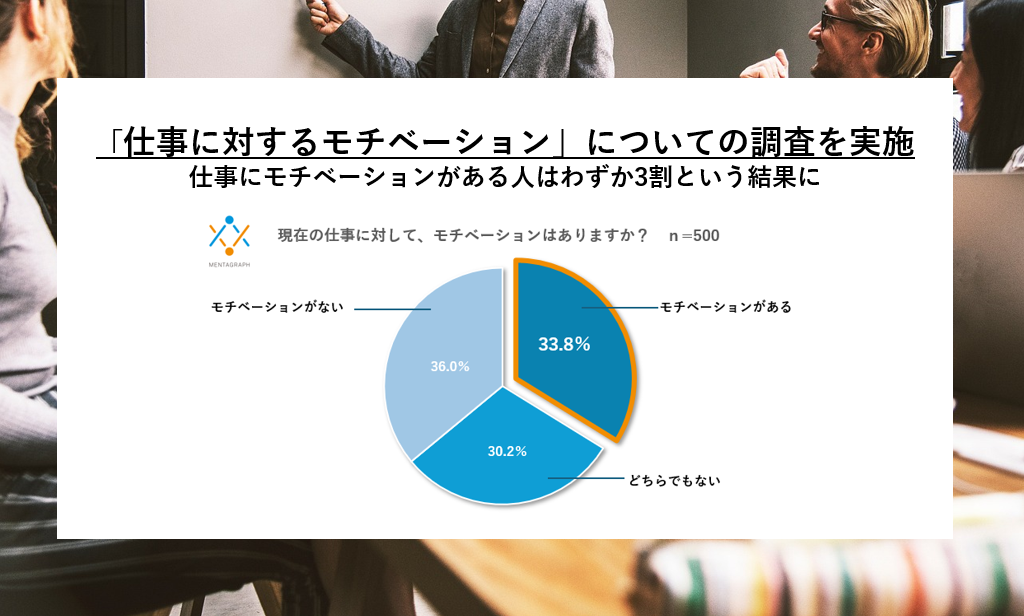
Only 30% of people are motivated at work

Survey on "work motivation" by generation

- Generation Z's values ​​are polarized between "salary" and "what they want to do"

MENTAGRAPH Inc. (Head office: Chuo-ku, Tokyo, a wholly owned consolidated subsidiary of JT) conducted a survey of 500 business people nationwide aged 20 to 65 to find out what motivates and rewards them at work. The survey results revealed differences in the elements that motivated and unmotivated people prioritize in their work, as well as the relationship between this and the "fun" and "rewarding" aspects of work.
「働き方改革」の次は「心のケア改革」
Survey Summary
・More than half of respondents answered that "salary is directly linked to increased motivation." "Salary" is a factor that increases work motivation across all generations.
・People who are less motivated at work are more likely to focus on "salary," while those who are more motivated tend to place more importance on "satisfaction" and "self-growth."
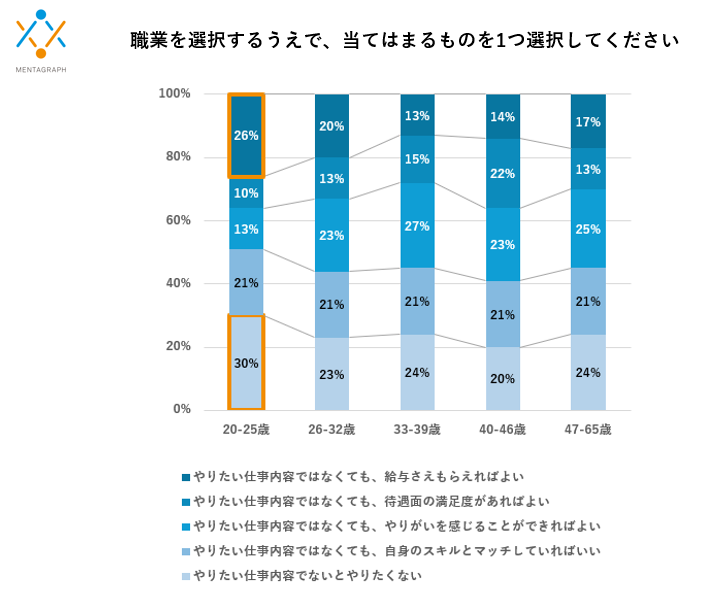
・Job choices among people in their 20s are polarized between those who "don't want to do anything unless it's a job they want to do" and those who "are happy even if it's not a job they want, as long as they get paid."

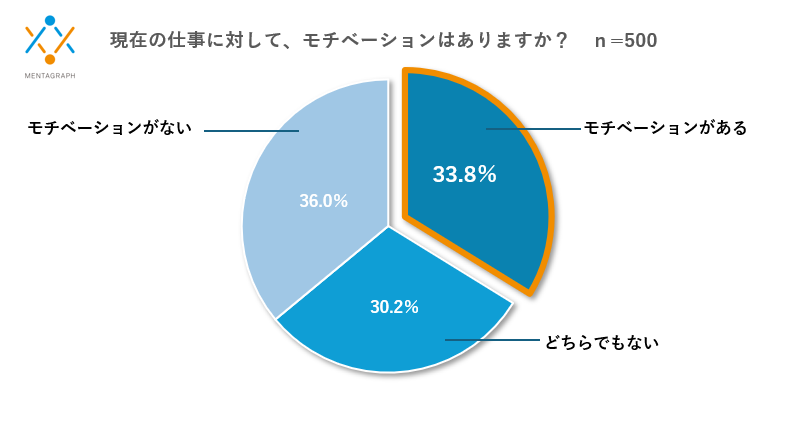
Only 30% of people are motivated to work! People with low motivation tend to place more importance on "salary."
When asked about their motivation for their current job, only 33.8% answered that they were "motivated." In a survey about factors that improve motivation, the most commonly cited factor was "salary" (54.2%). The percentage of people who cited salary as a motivating factor was high across all generations, showing that it is considered important regardless of age. (45.0% for those aged 20-25, 63.0% for those aged 26-32, 55% for those aged 33-39, 56% for those aged 40-46, and 58.0% for those aged 47-65)
「働き方改革」の次は「心のケア改革」
Following "salary," the next factor that improves motivation was "evaluation (career advancement, promotion, etc.)" at 38.6% and "job satisfaction" at 38.0%, showing how "salary" motivates many people.
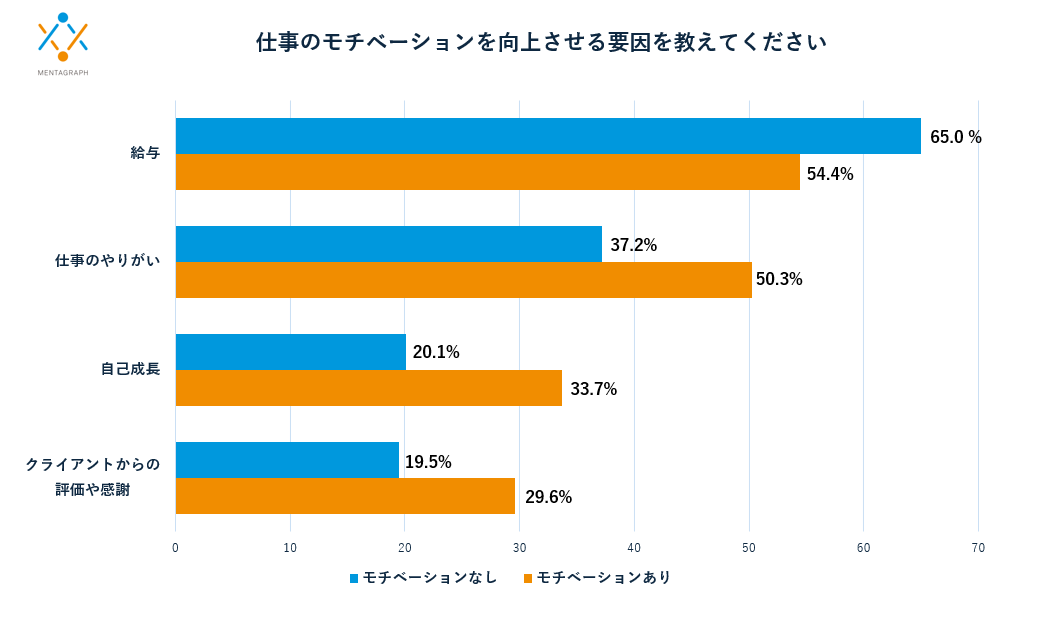
Furthermore, when we looked at the differences in factors that motivate motivated people and those who do not, we found that highly motivated people tend to cite internal values ​​such as "satisfaction with work" (motivated: 50.3%, unmotivated: 37.2%), "evaluation and gratitude from clients and customers" (motivated: 29.6%, unmotivated: 19.5%), and "self-growth" (motivated: 33.7%, unmotivated: 20.1%) as sources of motivation.
On the other hand, those who lacked motivation were more likely to cite "salary" (motivated: 54.4%, unmotivated: 65.0%).

「働き方改革」の次は「心のケア改革」
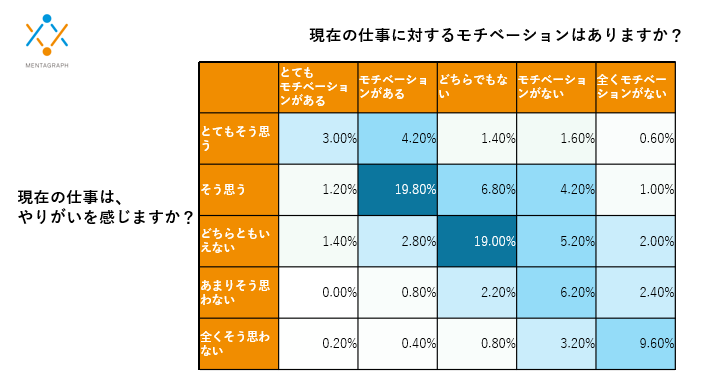
The correlation between work enjoyment, job satisfaction, and motivation has been revealed.
The survey results revealed a correlation between the three items "enjoying work," "feeling rewarding," and "it's work I want to do." Regarding enjoyment and rewarding work, 85.5% of those who "enjoy their current job" answered that they "feel rewarding," while 84.0% of those who "do not enjoy their job" answered that they "do not feel rewarded."
Regarding motivation and job satisfaction, 64.3% of those who "feel rewarded in their current job" answered that they "are motivated," while 82.94% of those who "do not feel rewarded" answered that they "are not motivated."
From the above results, it can be inferred that the more people enjoy their work, the more rewarding it is, which leads to motivation for work, and it is clear that a sense of psychological fulfillment is directly linked to motivation.
「働き方改革」の次は「心のケア改革」
「働き方改革」の次は「心のケア改革」
Generation Z's values ​​are polarized between "what they want to do" and "salary"
According to the survey results on attitudes towards choosing a job, among those aged 20 to 25, 30.0% answered "I don't want to do it unless it's a job I want to do" and 26.0% answered "It doesn't matter if it's not a job I want to do, as long as I get paid," showing a tendency for people to be divided into idealistic and pragmatic. On the other hand, among those aged 26 and over, the most common answer across all generations was "It's fine as long as I find the job rewarding," indicating a growing preference for realism.
「働き方改革」の次は「心のケア改革」
This survey found that while "salary" is the core of motivation for all generations, motivation at work is also influenced by whether people "find their work enjoyable" and "feel rewarding." Those who value "rewarding" and "fun" are becoming more motivated to work, and companies are also being asked to consider the importance of designing intrinsic rewards that go beyond simple treatment.
Survey Method: Online Survey
Survey Period: December 5–11, 2024
Survey Participants: 500 office workers aged 20–65
About MENTAGRAPH Inc.
MENTAGRAPH Inc. is a B2B company that provides the "Mental Battery Service," which visualizes the minds of workers, promotes appropriate breaks throughout the workplace, and supports optimal management. Born out of Japan Tobacco's (JT) corporate R&D organization, "D-LAB," the company promotes "mental care reform" by visualizing stress and fatigue, with a focus on "mental richness."
Its flagship product is the "Mental Battery" service, which consists of a wearable sensor called "mentoring," an app that recommends breaks, and a dashboard that manages the stress levels of the entire organization. This quantifies employee fatigue and stress in real time and visualizes appropriate break timing. Managers and HR can use this for organizational care.
It achieves "continuous and highly accurate measurement" that conventional stress checks could not achieve, leading to improved employee satisfaction, work efficiency, and team performance. We aim to create a society where "taking breaks" is a natural part of corporate culture.
Media Inquiries
Mentagraph PR Office (Platinum Inc.) Contacts: Hirotani, Ando, ​​Kanie
Tel: 03-5572-6072 / Fax: 03-5572-6075 / Email: mentagraph_pr@vectorinc.co.jp