MENTAGRAPH Inc. (Headquarters: Chuo-ku, Tokyo; a wholly owned consolidated subsidiary of JT) conducted a comparative analysis of the differences between managers' reality and subordinates' ideals regarding 1-on-1 meetings among 724 business people aged 20-65 nationwide (300 managers and 424 non-managerials). Results revealed significant gaps in operational rules for frequency, duration, and communication during meetings.

This survey was conducted to gain a comprehensive understanding of the effectiveness and operational challenges of 1-on-1 meetings, which are increasingly being adopted to support subordinates' growth and alleviate their anxieties and frustrations. We asked both supervisors and subordinates about their ideal and realistic expectations for each item, and then analyzed them, focusing on "supervisor's reality" and "subordinate's ideal."
First, when asked about the frequency of 1-on-1 meetings, we found that subordinates' preference for "as needed" was the biggest gap between their supervisor's reality and theirs. While 20% of subordinates' ideals were "as needed," only 6.3% of supervisors' actual expectations were met, with subordinates' ideals exceeding their supervisor's reality by 13.7 points. On the other hand, for regular frequencies such as "once a week," "every other week," and "once a month," subordinates' ideals were lower than their supervisors' actual expectations, suggesting a preference for ad hoc meetings when issues arise, rather than regular meetings.

Furthermore, when asked about the ideal length of time each meeting should take, 24.5% of subordinates ideally wanted "less than 15 minutes." Meanwhile, only 14.0% of supervisors' actual expectations were met, a 10.5-point gap. In contrast, for "less than 15 to 30 minutes," the supervisor's ideal was 53.3%, while the subordinate's ideal was 44.8%, with the supervisor's ideal exceeding the supervisor's ideal by 8.5 points, indicating that subordinates overall support short, intensive meeting designs.
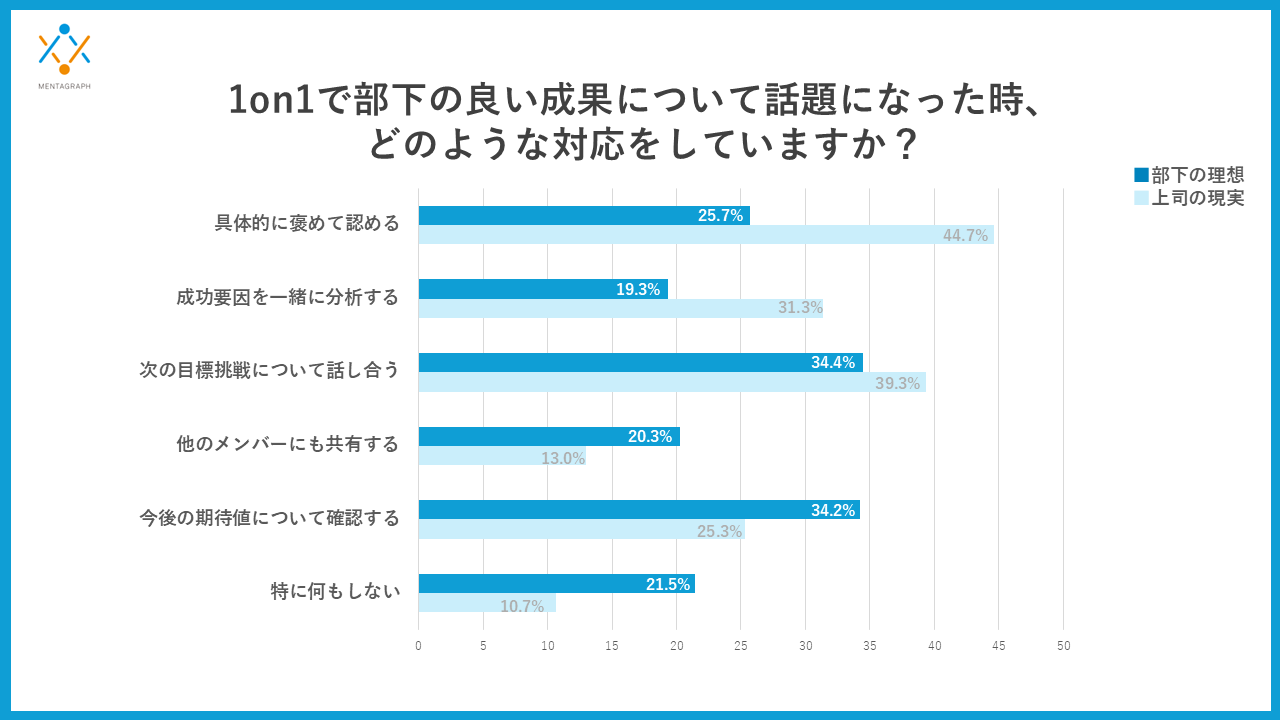
When it comes to how to respond when good results come up in one-on-one meetings, subordinates' ideal was "designing to move forward to the next step" more strongly than the supervisor's ideal. Specifically, for "confirming future expectations," the subordinate's ideal was 34.2%, while the supervisor's actual was 25.3%, exceeding the supervisor's ideal by 8.9 points. For "discussing the next goal challenge," the subordinate's ideal was 46.0% versus 39.3%, a gap of 6.7 points. On the other hand, for "doing nothing in particular," the subordinate's ideal was 21.5%, while the supervisor's actual was 10.7%, exceeding the subordinate's ideal by 10.8 points, suggesting that there is a certain demographic that prefers to move quietly on to the next step without overly hyping things up.
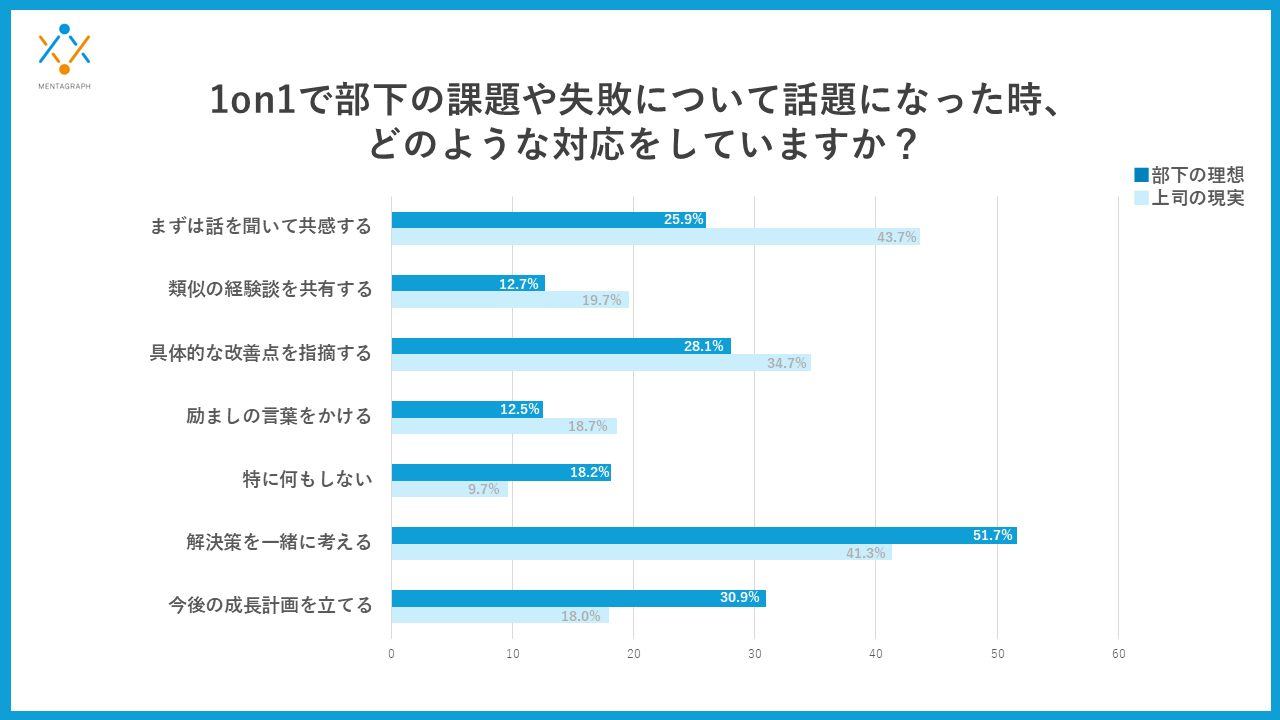
When faced with challenges or failures, there was a clear tendency for superiors to seek support that goes beyond empathy and leads to action. For "making future growth plans," 30.9% of subordinates idealized this, while only 18.0% of superiors actually did so, revealing a gap of 12.9 points. For "thinking together about solutions," 51.7% of subordinates idealized this, while 41.3% of superiors actually did. For "pointing out specific areas for improvement," 44.8% compared with 34.7%. Meanwhile, "first listening and empathizing" was roughly the same at around 45%, while "doing nothing in particular" was 18.2% compared with 9.7%, a gap of 8.5 points, confirming a preference for "not getting too involved" depending on the situation.
This survey revealed consistent gaps between "supervisors' reality" and "subordinates' ideal" in one-on-one meetings in terms of frequency, duration, and how they interact within the meetings. While subordinates prefer a design that is "as needed, short, and leads to next action," the reality is that on-site operations tend to be "regular, somewhat longer, and limited to observation and listening.
"In 1-on-1 meetings, by aligning and updating operational rules between superiors and subordinates, 1-on-1 meetings can be transformed from "routine" to "progressive dialogue," leading to greater satisfaction and improved performance on the ground.
Survey Method: Online Questionnaire
Survey Period: June 27–July 3, 2025
Analysis Period: November 15–December 15, 2025
Survey Participants: 724 business people aged 20–65 (300 managers and 424 non-managers)
About MENTAGRAPH, Inc.
MENTAGRAPH Inc. is a B2B company that provides the "Mental Battery Service," which visualizes employees' mental states, promotes appropriate breaks throughout the workplace, and supports optimal management. Born from Japan Tobacco's (JT) corporate R&D organization, D-LAB, the company promotes "mental care reform" by visualizing stress and fatigue, centered on "mental richness."
Its flagship product is the "Mental Battery" service, which consists of the wearable sensor "Mentoring," app-based break recommendation, and dashboard-based management of the organization's overall stress level. This quantifies employee fatigue and stress in real time and visualizes appropriate break timing. Managers and HR can use this information for organizational care.
It achieves "continuous and highly accurate measurement" that traditional stress checks could not achieve, leading to improved employee satisfaction, work efficiency, and team performance. The company aims to create a society where "taking breaks" is a natural part of corporate culture.