MENTAGRAPH Inc. (Head office: Chuo-ku, Tokyo; a wholly owned consolidated subsidiary of JT) conducted a survey on "harassment standards" targeting 1,800 business people nationwide aged 22 to 65 (900 managers and 900 non-managerial employees). The results revealed that non-managerial employees are more sensitive to "physical contact" and "intrusion into private time," and that actions such as "business contact via LINE," "tapping on the shoulder," and "calling someone by their first name" tend to be perceived as harassment.

The purpose of this survey was to clarify the actual "line of tolerance in the workplace" regarding the unclear topic of "the boundaries of harassment."
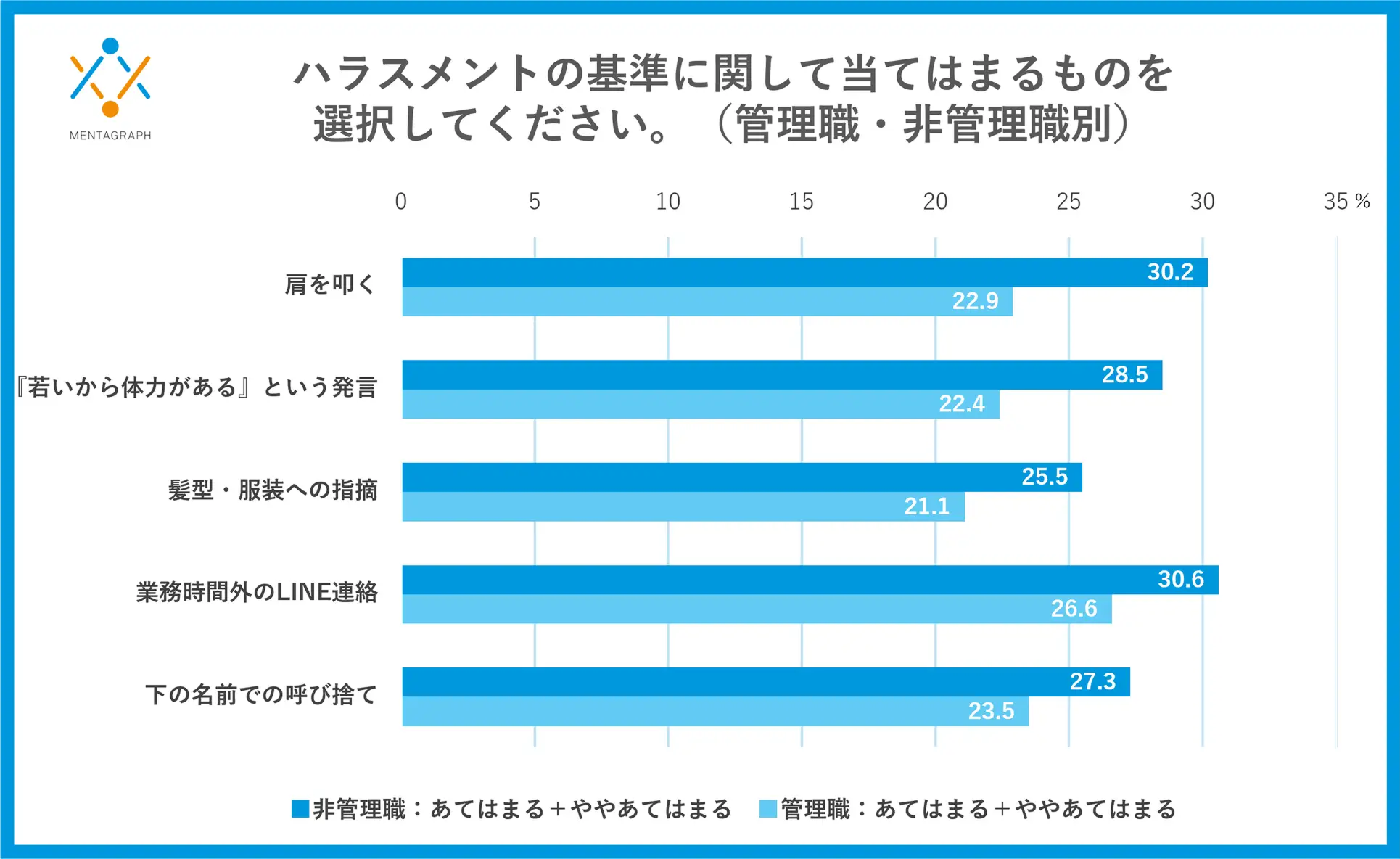
Respondents were asked to rate various behaviors occurring during work hours on a 5-point scale, with the question, "Please select the most appropriate criteria for harassment." The most common response (answering "applies" or "somewhat applies") to harassment was "LINE communication outside of work hours" at 28.6% (non-managerial 30.6% / managerial 26.6%). This was followed by "tapping someone on the shoulder" at 26.6% (non-managerial 30.2% / managerial 22.9%), followed by "comments like 'you're young and have a lot of stamina'" and "calling someone by their first name" at 25.4%. Meanwhile, "yelling at someone while giving instructions at work" was only given at 14.9% (non-managerial 16.0% / managerial 13.9%), suggesting that physical contact and calling someone by their first name are more likely to be considered problematic than shouting.
Items with high harassment recognition (overall, top 5)
- 1st place: LINE communication outside of working hours (28.6%)
- 2nd place: Tapping on the shoulder (26.6%)
- 3rd place: "You're young, so you have a lot of stamina" (25.4%)
- 4th place: Calling someone by their first name (25.4%)
- 5th place: Comments about hairstyle or clothing (23.3%)
Additionally, the biggest difference in perception between managers and non-managers was the act of "patting someone on the shoulder," with 30.2% of non-managers and 22.9% of managers agreeing, resulting in a gap of +7.3 points. This was followed by "telling someone they're young and have a lot of stamina" at +6.0 points (non-managers 28.5% / managers 22.4%), "commenting on their hairstyle or clothing" at +4.3 points (non-managers 25.5% / managers 21.1%), "contacting them on LINE outside of working hours" at +4.0 points (non-managers 30.6% / managers 26.6%), and "calling them by their first name" at +3.9 points (non-managers: 27.3% / managers: 23.5%).
All of these actions involve "gray-line behaviors" such as physical contact, comments about attributes or appearance, and intrusion into private time. While those on the front lines (non-managerial staff) are keen to see these as risks, managers tend to see them as "a form of communication" or "part of guidance," suggesting that the line may be loosely drawn.
Top 5 areas where there is a large "awareness gap" between managers and non-managers (non-managers/managers)
- 1st place: Tapping on the shoulder (7.3 percentage points difference | Non-managerial 30.2% / Managerial 22.9%)
- 2nd place: "You're young, so you have a lot of stamina" (6.0 point difference: 28.5% of non-managers, 22.4% of managers)
- 3rd place: Remarks about hairstyle and clothing (4.3 percentage point difference | Non-managerial 25.5% / Managerial 21.1%)
- 4th place: LINE communication outside of working hours (4.0 point difference | Non-managerial 30.6% / Managerial 26.6%)
- 5th place: Calling people by their first name (3.9 percentage point difference: 27.3% of non-managers / 23.5% of managers)
Furthermore, when managers were asked about "experiences where they were perceived differently than they intended," the most common answer was "understanding subordinates' interests and characteristics," at 57.0%. This was followed by "communicating company policy" at 12.2% and "goal and progress management" at 10.7%. Even when involvement is intended to be supportive, there is a risk that it may come across as prying or interfering, so it is necessary to go through the process of sharing goals, obtaining consent, and agreeing on frequency, and to clarify in advance the scope of information that will be handled.
The rankings reveal that non-managerial employees have stricter standards in areas related to interpersonal boundaries, such as contacting employees during their private time, physical contact, addressing them by name, referring to their attributes, and commenting on their appearance. Companies can create a better management environment by making these awareness gaps visible and creating opportunities for managers and subordinates to align their expectations.
Survey method: Online questionnaire
Survey period: December 3rd to December 17th, 2024
Analysis period: August 15th to August 31st, 2025
Survey participants: 1,800 business people aged 22 to 65 (900 managers and 900 non-managers)
About MENTAGRAPH, Inc.
MENTAGRAPH, Inc. is a B2B company that provides the "Mental Battery Service," which visualizes employees' mental states, promotes appropriate breaks throughout the workplace, and supports optimal management. Born from Japan Tobacco's (JT) corporate R&D organization, "D-LAB," the company promotes "mental care reform" by visualizing stress and fatigue, centered on "mental richness." Its flagship product, the "Mental Battery" service, comprises a wearable sensor called "mentoring," break recommendations via an app, and dashboard management of the organization's overall stress level. This service quantifies employee fatigue and stress in real time and visualizes appropriate break timing. It can be used by managers and HR personnel for organizational care. It achieves "continuous and highly accurate measurement," something traditional stress checks could not achieve, leading to improved employee satisfaction, work efficiency, and team performance. The company aims to create a society where "taking breaks" is a natural part of corporate culture.