Is it okay to take a nap during your lunch break? Survey reveals differences in standards between managers and non-managerials

- Survey conducted on "ease of taking breaks" and "perception of overtime hours" -

Clear gap in awareness between employees and managers regarding the line that defines overtime hours as "too much"

MENTAGRAPH Inc. (Head office: Chuo-ku, Tokyo; a wholly owned consolidated subsidiary of JT) conducted a survey of 1,800 business people nationwide aged 22 to 65 (900 managers and 900 non-managerial employees) regarding the ease of taking breaks during work and their perception of overtime hours. The survey revealed that managers tend to be relatively reluctant to nap during breaks, while non-managerial employees are more tolerant. It also revealed issues with workplace culture, where the perceptions of others and the behavior of superiors discourage people from taking breaks, and a mismatch in standards for determining when overtime is considered.
「働き方改革」の次は「心のケア改革」
It's hard to take a break in front of your boss...? The reason why it's hard to take a break at work is revealed.
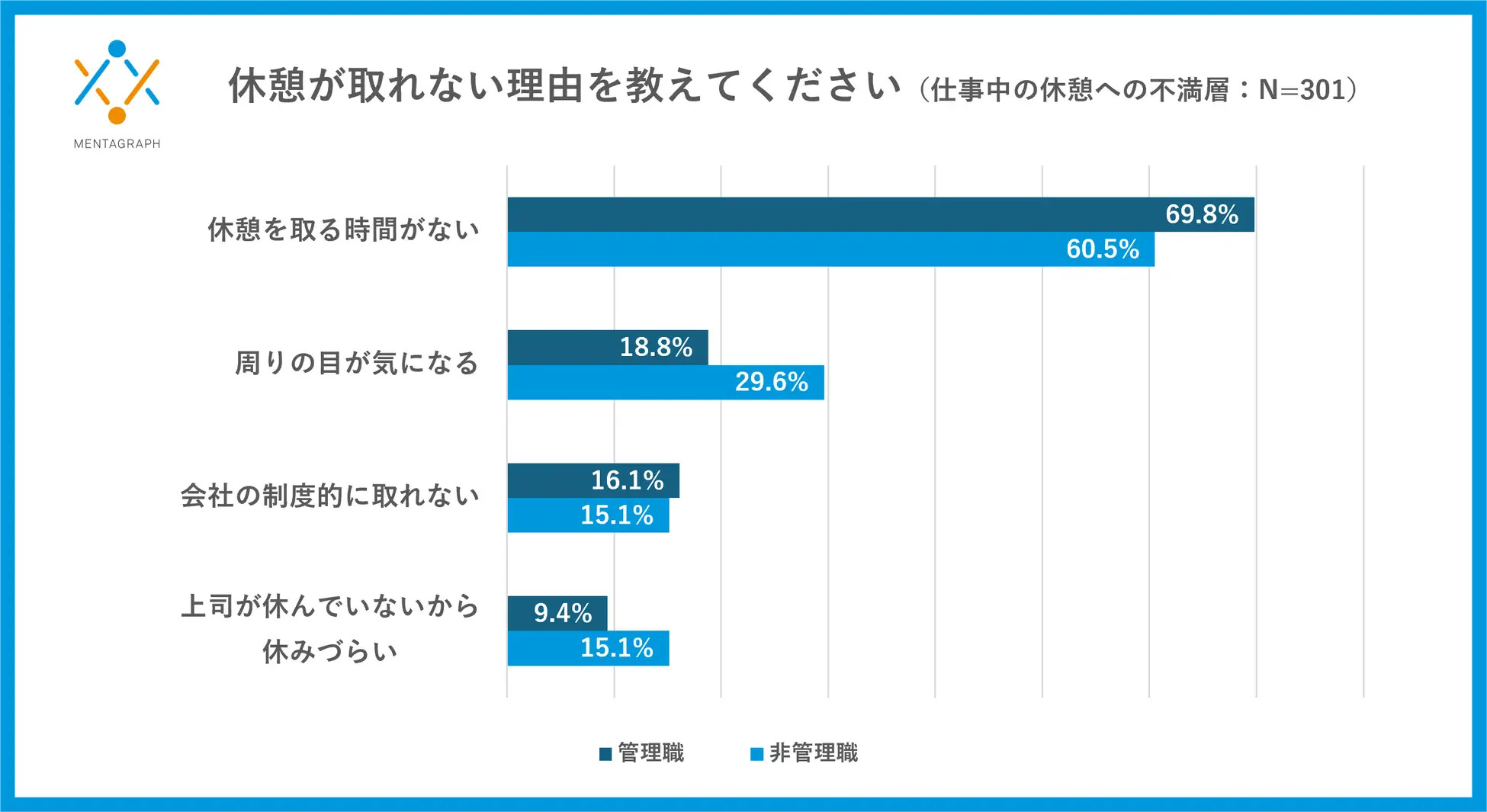
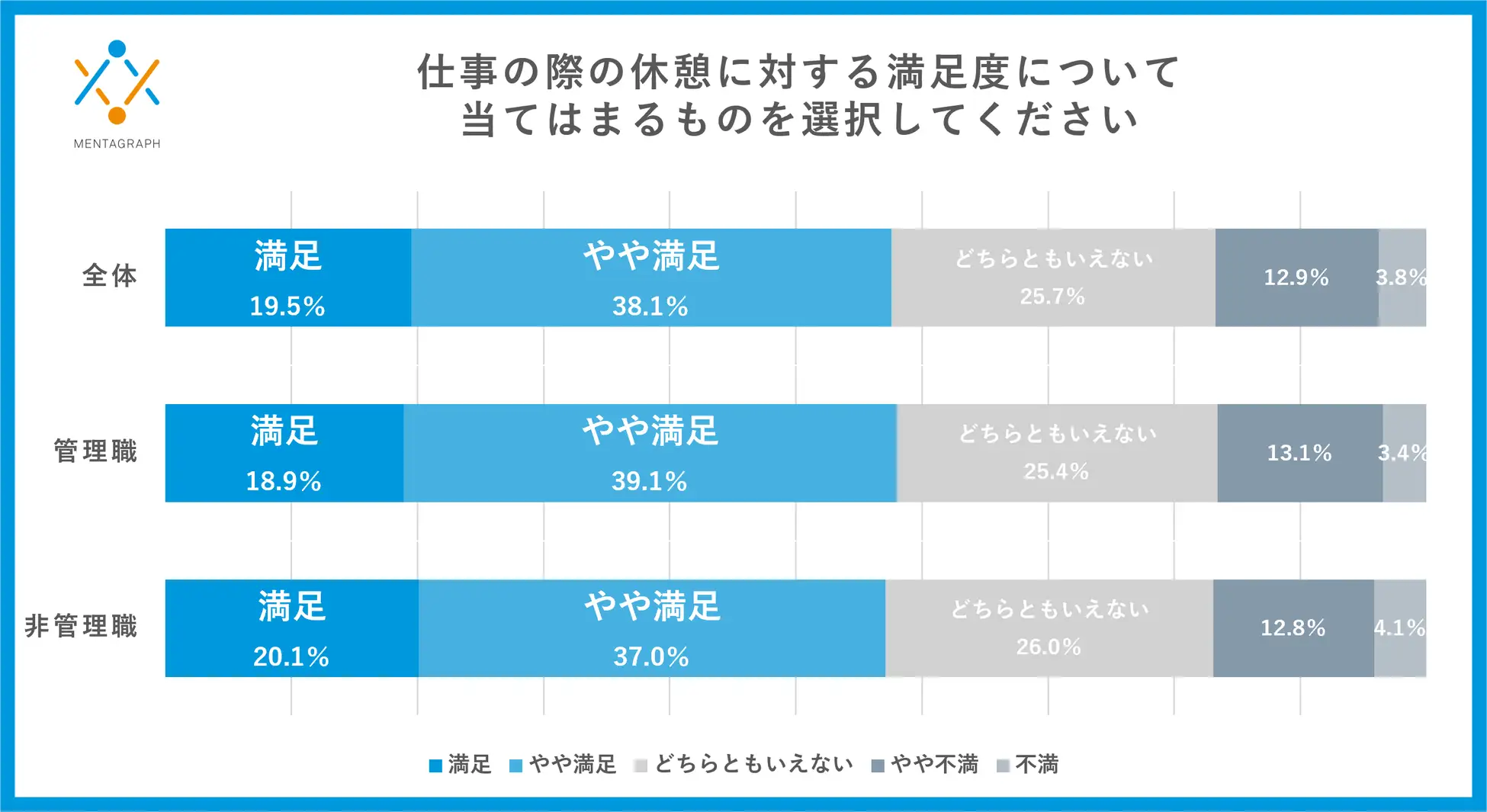
This survey investigated satisfaction with breaks during work hours. Those who answered "satisfied" or "somewhat satisfied" with breaks during work hours accounted for 57.6% of the overall total, with managers at 58.0% and non-managerial employees at 57.1%, showing no significant difference between job titles. The "dissatisfied" group ("somewhat dissatisfied" or "dissatisfied") also accounted for 16.7% of the overall total, with managers at 16.6% and non-managerial employees at 16.9%, demonstrating a small difference between job titles. When those dissatisfied with breaks during work hours ("somewhat dissatisfied" or "dissatisfied," N=301) were asked why they were unable to take breaks, 65.1% of the overall respondents cited "I don't have time to take a break," with work-related circumstances being the main reason. Among non-managerial employees, relatively high responses included "I'm worried about what others think" (29.6%) and "It's difficult to take a break because my superiors aren't taking breaks" (15.1%), revealing that "how you look" and superiors' behavior are barriers to taking breaks. Institutional factors ("it is not possible to take this measure due to the company's system") were cited by only a small proportion of both managers (16.1%) and non-managerials (15.1%).
「働き方改革」の次は「心のケア改革」
Furthermore, in a survey about thoughts on "how superiors should take breaks" and "how subordinates should take breaks," 70.6% (applicable + somewhat applicable) agreed with the value that "everyone should take breaks equally regardless of position," while 16.6% agreed with the value that "superiors should not take breaks in sight of subordinates," and 11.7% agreed with the value that "subordinates should not take breaks in sight of their superiors," indicating that there remains some hesitation about "visible breaks." In other words, despite widespread agreement that "everyone should take breaks equally," when it comes to actual action, "the eyes of others" and "the role model of superiors" act as brakes, creating friction in the workplace culture that makes it difficult to take breaks.
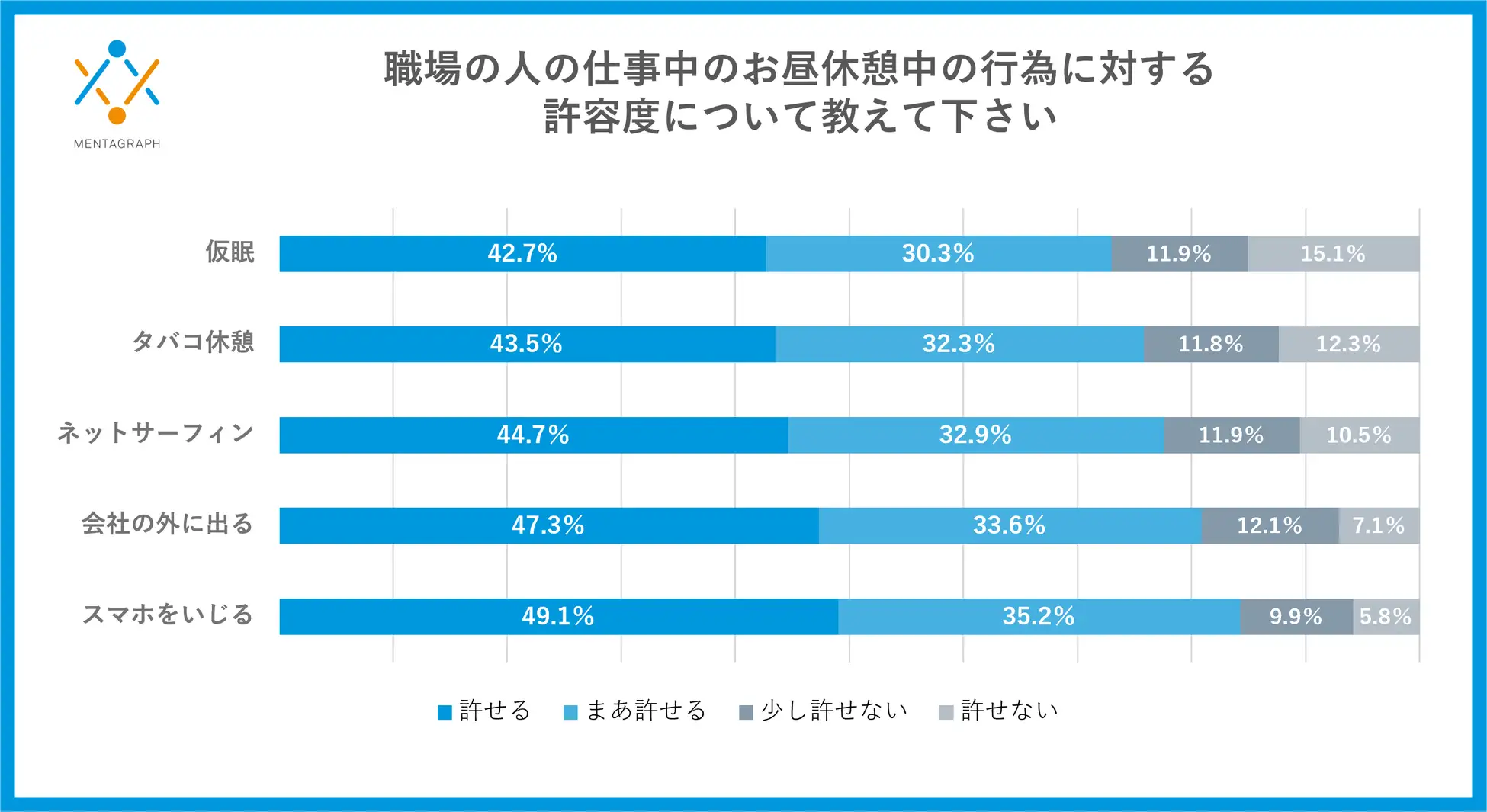
Respondents were asked to rate their tolerance for lunch break behavior with four choices: "acceptable/somewhat acceptable/somewhat unacceptable/unacceptable." The most acceptable behavior was "playing with your smartphone" at 84.3% (49.0% acceptable + 35.2% somewhat acceptable). This was followed by "going outside the office" at 80.9%, "surfing the web" at 77.6%, "cigarette break" at 75.8%, and "sleeping (nap)" at 73.0%. Regarding napping during lunch breaks (acceptable: 73.0%), 70.0% of managers and 76.0% of non-managers were tolerant, with non-managers being 6.0 points more tolerant. Conversely, managers were more negative about the behavior they disallowed ("somewhat unacceptable" + "unacceptable"), with 30.0% of managers and 24.0% of non-managers.
「働き方改革」の次は「心のケア改革」
Even during the lunch break, supervisors are wary of naps, while those on the front lines accept them for practical reasons. This suggests that differences in values ​​regarding how to take rest may also affect workplace decisions regarding how to take time off.
Does "too much" overtime start at 20 hours or 40 hours? What is the dividing line between managers and non-managerials?
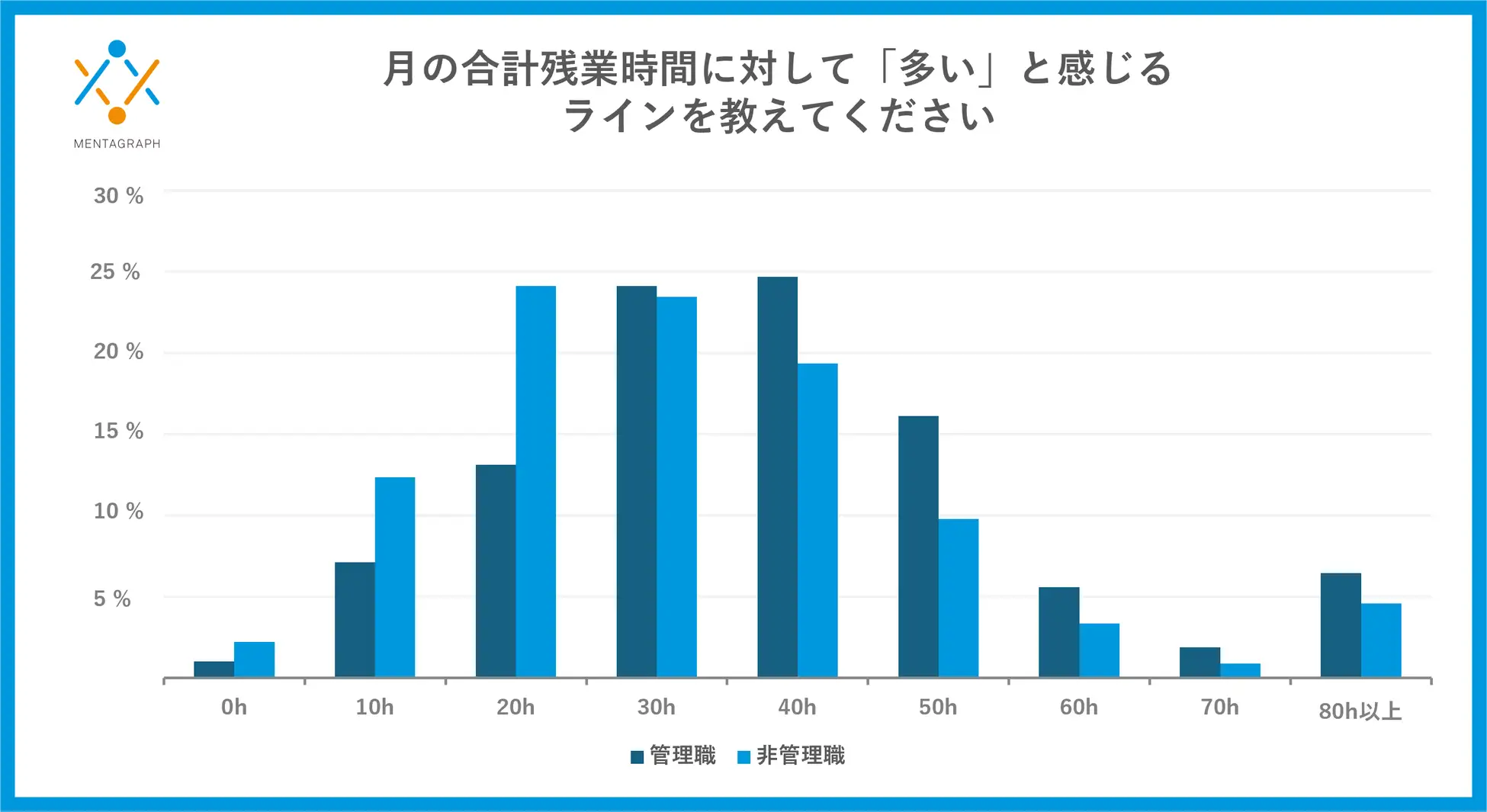
This survey asked respondents what percentage of total monthly overtime hours they consider "too much." Overall, 30 hours was the most common starting point, with 23.8% considering it "too much." However, a breakdown revealed that the distribution varied by position. Non-managerial employees, with 24.1% considering 20 hours "too much," followed by 30 hours (23.4%) and 40 hours (19.3%), respectively. Meanwhile, managers considered 40 hours (24.7%), 30 hours (24.1%), and 50 hours (16.1%). In other words, non-managerial employees tend to consider an early period (in the 20s) to be "too much," while managers tend to tolerate periods of overtime up to a later stage (in the 30s and 40s). The percentage of non-managerial employees who considered "20 hours or less" to be "too much" was 38.7% and 21.2% of managers. On the other hand, 54.7% of managers and 37.9% of non-managerials consider 40 hours or more to be too much, indicating that managers tend to have a lower tolerance for work.
「働き方改革」の次は「心のケア改革」
This gap means that even if the overtime hours are the same, the workplace may quickly perceive them as "excessive," while superiors may view them as still within the acceptable range. Resolving the subtle gaps in perception between managers and non-managerial staff regarding "breaks" and "overtime" will lead to more reasonable break times and reduced overtime within the company.
Survey Method: Online Survey
Survey Period: December 3–17, 2024
Analysis Period: August 1–15, 2025
Survey Participants: 1,800 business people aged 22–65 (900 managers and 900 non-managerials)
About MENTAGRAPH Inc.
MENTAGRAPH Inc. is a B2B company that provides the "Mental Battery Service," which visualizes the minds of workers, promotes appropriate breaks throughout the workplace, and supports optimal management. Born out of Japan Tobacco's (JT) corporate R&D organization, "D-LAB," the company promotes "mental care reform" by visualizing stress and fatigue, with a focus on "mental richness."
Its flagship product is the "Mental Battery" service, which consists of a wearable sensor called "mentoring," an app that recommends breaks, and a dashboard that manages the stress levels of the entire organization. This quantifies employee fatigue and stress in real time and visualizes appropriate break timing. Managers and HR can use this for organizational care.
It achieves "continuous and highly accurate measurement" that conventional stress checks could not achieve, leading to improved employee satisfaction, work efficiency, and team performance. We aim to create a society where "taking breaks" is a natural part of corporate culture.
Media Inquiries
Mentagraph PR Office (Platinum Co., Ltd.) Contact: Hirotani, Ando, ​​Kanie
Tel: 03-5572-6072 / Fax: 03-5572-6075 / Email: mentagraph_pr@vectorinc.co.j